Common Information Analysis
User Reviews and Experience
-
Overall User Satisfaction:
Mixed, with a significant number of users expressing dissatisfaction and labeling the app as a scam, citing issues with reward redemption and lack of developer support. Some users do report positive experiences and successful redemptions.
-
Common User Feedback:
Frequent complaints revolve around the inability to redeem earned gift cards, delayed or non-existent payouts, and poor customer support responsiveness. Some users also mention the increasing frequency of ads and app glitches.
-
User Rating Distribution:
While some reviews give 5 stars to be seen, the underlying sentiment in many detailed reviews points to frustration and disappointment. The app has a generally positive rating on app stores, but this is often contradicted by the qualitative feedback.
-
Most Appreciated Features:
The core concept of earning rewards for walking is appealing. Some users appreciate the gamified elements like mini-games and the AI health diagnosis feature.
-
Common Complaints:
The most significant complaint is the app being a "scam" due to failed reward redemptions, misleading promises about gift cards, and extremely long waiting times for payouts (months to years). Issues with inaccurate step tracking and app crashes are also noted.
Technical Performance
-
App Size and Requirements:
The APK size is around 98.1 MB to 209.1 MB, requiring Android 8.1+ or iOS 15.1+.
-
Battery Consumption:
Not explicitly detailed, but typical for step-tracking apps that run in the background.
-
Loading Speed:
Mixed reports; some users experience loading issues and app crashes.
-
Stability:
Users report app crashes and glitches, especially after updates or when attempting to redeem rewards.
-
Offline Capabilities:
Step tracking might function offline, but reward redemption and access to most features require an internet connection.
Updates and Maintenance
-
Update Frequency:
The app is updated relatively frequently, with changes focusing on bug fixes and performance improvements. Latest versions mentioned are 1.96.1 and 1.93.0.
-
Latest Version Changes:
Primarily bug fixes and performance enhancements. Some past updates have introduced new features like games or improved gift card redemption options.
-
Bug Fix Response Time:
Developer responses to issues are often generic, directing users to FAQs or the in-app Help Center, with many users reporting a lack of actual resolution or personalized support.
-
Developer Support Quality:
Largely criticized for being unresponsive, unhelpful, and relying on automated responses.
Security and Privacy
-
Data Collection Practices:
Collects usage data, diagnostics, location, personal information, app activity, device IDs, and potentially health & fitness data.
-
Privacy Policy Clarity:
Standard privacy policies are provided, but the extent of data sharing with third parties (location, app activity, device IDs) raises privacy concerns for some users.
-
Security Measures:
Data is encrypted in transit. Users can request data deletion. The app has passed APKPure's initial safety checks and has been verified safe by Virustotal.
-
Permission Requirements:
Requires foreground service, boot completed, and optionally physical activity recognition, notifications, and contact read (for inviting friends).
-
Data Storage Methods:
Not explicitly detailed, but standard cloud storage practices are implied.
Monetization Strategy
-
Pricing Model:
Free to download and use.
-
In-app Purchases:
Primarily through ads and potentially offers for faster point accumulation or ad removal (e.g., "Turbo" feature).
-
Subscription Options:
No explicit subscription options are mentioned for core functionality.
-
Free vs Paid Features:
The core step-tracking and reward system is free, but the ability to earn meaningful rewards often involves watching numerous ads or engaging with other monetization features.
-
Value for Money:
Generally considered low by many users due to the significant time investment required to earn minimal rewards and the frequent issues with redemption.
Market Position
-
Competitor Comparison:
Competes with other step-counting and reward apps like Sweatcoin, CashWalk, Winwalk, and WeWard. Competitors like Atlas Earth and Bitcoin Miner are cited as better alternatives by dissatisfied users.
-
Market Share:
With over 1 million downloads on Google Play and significant download numbers on other platforms, it has a notable presence in the reward app market.
-
Unique Selling Points:
The integration of AI health diagnosis and diet logging alongside step counting and rewards is a differentiator. The gamified elements (games, challenges) also aim to enhance engagement.
-
Target Audience Fit:
Appeals to individuals looking for motivation to walk more and earn rewards, particularly office workers and students interested in fitness and managing their health passively.
Category-Specific Analysis (Health & Fitness)
Workout Features
-
Exercise Library:
Not a primary focus; the app centers on walking.
-
Workout Plans:
None explicitly detailed, beyond encouraging more walking.
-
Form Guidance:
No specific features for exercise form.
-
Video Tutorials:
None mentioned.
-
Custom Routines:
Users can set personal goals (e.g., step count), but custom workout routines are not a feature.
-
Training Programs:
The app implicitly encourages consistent daily activity rather than structured training programs.
Health Tracking
-
Vital Signs Monitoring:
Includes an AI-based health diagnosis feature that analyzes health status via camera.
-
Activity Tracking:
Primarily tracks steps using the phone's motion sensors. Some integration with phone's health data may occur.
-
Sleep Analysis:
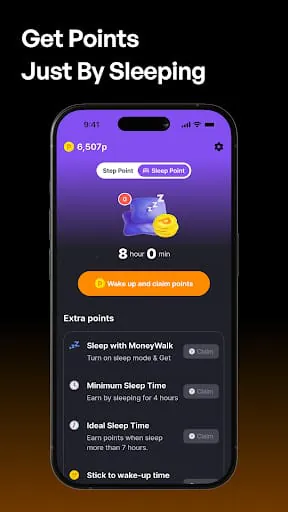
Offers points for good sleep, though this feature is noted as problematic for night-shift workers.
-
Nutrition Logging:
Includes a diet log for users to track meals and earn points.
-
Weight Management:
Indirectly supported by encouraging physical activity.
-
Progress Charts:
Step history and progress are implicitly tracked for reward calculations.
Device Integration
-
Wearable Compatibility:
Not explicitly detailed for Moneywalk, but similar apps (like Cashwalk) mention compatibility with Wear OS and syncing with health platforms like Samsung Health, Fitbit, Garmin, Mi Band. Moneywalk primarily uses phone sensors.
-
Health Kit Integration:
Appears to utilize phone's health data, with comparisons made to Apple Health step counts by users.
-
Sensor Accuracy:
Relies on phone's built-in pedometer, which can be less accurate than dedicated wearables. Users sometimes report discrepancies compared to other health apps.
-
Data Sync:
Data syncs with the app's internal reward system.
-
Real-time Monitoring:
Step count is likely updated in near real-time when the app is active or background services are running.
-
Cross-device Support:
Primarily mobile-focused (Android and iOS).
Nutrition Features
-
Food Database:
Not mentioned; users log meals manually in the diet log.
-
Meal Planning:
No features for meal planning.
-
Calorie Tracking:
The diet log implies some form of calorie tracking, though not explicitly detailed.
-
Dietary Restrictions:
Not specified.
-
Recipe Suggestions:
None mentioned.
-
Macro Tracking:
Not mentioned.
Professional Guidance
-
Expert Advice:
Offers AI-based health diagnosis and personalized advice.
-
Personal Coaching:
No personal coaching features.
-
Form Correction:
Not available.
-
Workout Tips:
Provides tips on incorporating more physical activity.
-
Health Insights:
AI diagnosis provides insights into physical condition.
-
Community Support:
Users can share goals and achievements, fostering a sense of community and motivation.
Goal Management
-
Goal Setting:
Users can set daily step goals.
-
Progress Tracking:
Tracks daily steps and overall point accumulation towards rewards.
-
Achievement System:
Points and rewards act as achievements. Some gamified elements might offer badges.
-
Milestone Rewards:
Points are awarded for reaching step milestones (e.g., 5,000 steps, 10,000 steps).
-
Habit Formation:
Aims to encourage the habit of regular walking and physical activity.
-
Performance Analytics:
Provides step history and earnings, but detailed performance analytics are limited.
Moments of Insight
The core promise of "Moneywalk"—turning physical exertion into tangible rewards—is a potent concept. It taps into the human desire for motivation and the pursuit of easier paths to wellness. The app offers a digital bridge, suggesting that even mundane daily activities like walking can be financially beneficial. This immediate feedback loop, where steps translate to points, provides a sense of accomplishment and can gently nudge users towards a more active lifestyle.
Balanced Perspectives
While the idea of earning rewards for walking is appealing, the reality presented by many user reviews paints a more complex picture. The app's potential to promote health is overshadowed by significant concerns regarding its reward system's efficacy and transparency. Many users report extensive effort leading to little to no reward, with issues surrounding gift card redemption being a persistent problem. This disparity between the app's promise and users' experiences creates a critical imbalance, suggesting that while the intention is positive, the execution falls short for a substantial portion of its user base.
Mindful Observations
The "Moneywalk" app attempts to integrate technology into daily routines with a focus on health and financial incentives. Its design prioritizes simplicity in step tracking, aiming to be unobtrusive. The inclusion of gamified elements and an AI health check-in hints at a broader vision of digital well-being. However, the user experience is significantly hampered by the perceived lack of genuine rewards and developer support. This friction point detracts from the app's potential to foster peace of mind, instead introducing frustration and doubt about the technology's reliability.
Thoughtful Reflections
In an era where digital tools can either isolate or connect us, "Moneywalk" attempts to foster a connection between physical health and digital rewards. The aspiration is to create a positive feedback loop where healthy habits are intrinsically and extrinsically reinforced. However, for technology to truly enhance well-being, it must be built on a foundation of trust and transparency. The recurring complaints about the reward system suggest a disconnect between the app's intentions and its impact on user trust, highlighting the importance of ethical design in reward-based applications.
Harmonious Integrations
The app's integration of step counting with gamified elements and health insights offers a holistic approach to digital wellness. It aims to simplify the user's journey towards a healthier lifestyle by making it interactive and rewarding. Ideally, such an app would seamlessly fit into a user's day, providing gentle encouragement without becoming a source of stress. While the intention is to create harmony between user needs and technological solutions, the current execution, particularly concerning reward fulfillment, appears to disrupt this harmony for many, indicating areas where design and operational practices could be refined.
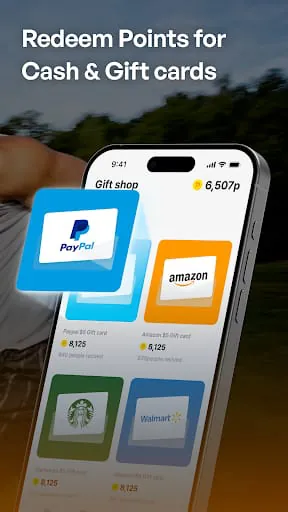
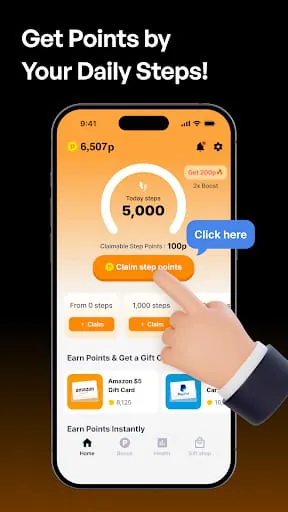
The MoneyWalk step counter presents an innovative approach to incentivizing physical activity, particularly walking. By directly linking steps taken to earning points, which can then be redeemed for gift cards, the application taps into a powerful motivational driver. The core proposition is straightforward: the more you walk, the more you earn. This gamified fitness model aims to transform a mundane daily activity into a rewarding experience. The app promises that a mere 5,000 steps, achievable in approximately 10 minutes, can yield 200 points, setting an accessible entry point for users. This immediate reward structure is designed to foster consistent engagement and encourage users to integrate more walking into their daily routines.
The earning mechanism is structured to offer increasing rewards. Users earn one point for every 100 steps up to the 5,000-step milestone. Beyond this initial threshold, bonus points are awarded for every additional 1,000 steps walked, up to 10,000 steps. This tiered reward system encourages users to push their limits and aim for higher step counts, thereby maximizing their earning potential. The ultimate conversion of these accumulated points into gift cards provides a tangible benefit, adding a layer of practicality to the fitness initiative. Beyond the direct monetary incentive, MoneyWalk also emphasizes its utility as a tool for health management. It is positioned as an ideal solution for individuals seeking a free walking app, a reward application for engaging in physical activity, or simply a method to monitor and improve their overall health status.
MoneyWalk is particularly well-suited for specific demographics. Office workers, who often face sedentary lifestyles, can leverage the app to introduce regular walking breaks and combat inactivity. College students embarking on weight-loss journeys will find the app a supportive companion, offering both motivation and a tangible reward system to complement their diet and exercise plans. Furthermore, individuals seeking to inject an element of enjoyment into their walking routines will appreciate MoneyWalk's ability to make the process more engaging. The application's permission requests, including foreground services for user activity, boot completion for auto-start, and optional activity recognition for accurate step counting, are standard for this type of application and are designed to ensure a seamless and effective user experience. The inclusion of contact permissions for friend invitations suggests a social component, further enhancing the app's appeal by allowing users to share their progress and motivate each other.